
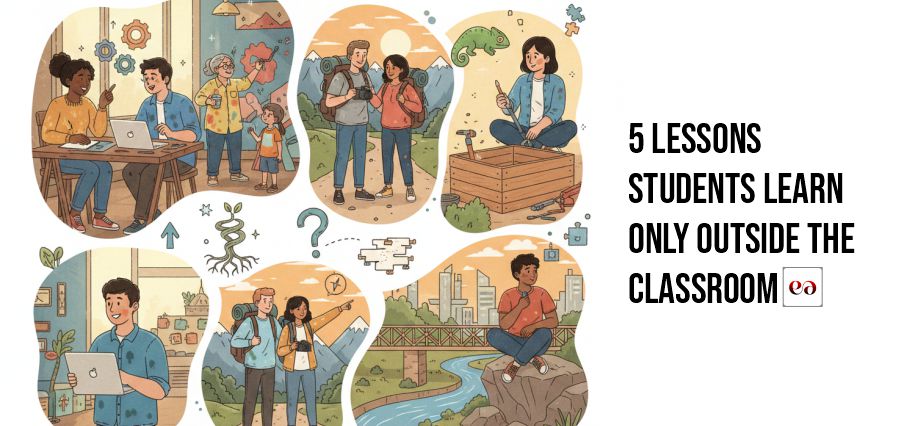
School teaches equations, grammar rules, experiments, and essays. All of that matters. But the biggest shifts in a young person’s life often happen far from textbooks. Growth shows up during awkward conversations, real mistakes, and unexpected challenges. These moments shape confidence, build resilience, and reveal how the world actually moves.
Let us explore five powerful lessons students truly understand only when they step beyond the classroom walls.
In school, problems usually come with one correct solution. Outside, life delivers situations that are messy, layered, and unpredictable. A bus breaks down. A project partner disappears. Plans fail even after serious effort. There is no matching page number with the explanation.
Students discover that problem-solving is a mindset. It requires staying calm, evaluating options, and making choices even when the outcome is unclear. They learn to:
This is practical intelligence. It grows through practice, not instruction. Over time, students realize that uncertainty is not the enemy. It is simply part of the process. The ability to respond instead of panic becomes one of their strongest skills.
Many students assume success is mostly about marks. Then they step into internships, events, group work, or part-time jobs and notice something surprising. People who communicate clearly often move ahead faster than those with higher scores.
Outside the classroom they see that communication is not only speaking. It includes listening, empathy, tone, and confidence. It also involves reading the room and understanding timing. A thoughtful message can open doors. A careless one can quietly shut them.
Students learn that ideas gain power only when others understand them. They begin to practice:
At some point it becomes obvious. Strong communication builds trust. Trust creates opportunities. And those opportunities shape careers as much as any certificate.
Inside classrooms, failure often feels like a label. Outside, students discover that failure functions more like information. A startup fails, and founders take notes. A musician releases songs that nobody hears, then studies the audience and tries again. Athletes lose matches, review mistakes, and come back stronger.
This shift is transformative.
Students begin to see setbacks as feedback. Instead of asking “Why did I fail,” they start asking “What did this teach me”. That small change produces emotional resilience. They understand that growth requires discomfort, patience, and honesty with oneself.
They also learn to separate self-worth from outcomes. A poor result does not define identity. It simply highlights where skills still need work. Over time, failure stops feeling like an attack. It becomes a teacher.
The classroom rarely replicates this emotional journey. Real life forces it, gently but firmly.
Many imagine networking as exchanging business cards or adding contacts online. Outside, they discover something deeper. Meaningful connections form through shared experiences, reliability, and genuine interest in others.
Students notice that people remember those who:
This is not manipulation. It is learning how communities function. One introduction can lead to a job. One conversation can spark a collaboration. One mentor can change how a student sees the world.
The most important realization arrives slowly. Networking is about contribution. When students focus on learning, supporting, and staying curious, relationships grow naturally. Over time, opportunity flows through those relationships because trust already exists.
This is a lesson classrooms rarely teach directly, but life repeats it again and again.
Outside the classroom, there is no teacher reminding anyone to finish work, sleep on time, or manage distractions. Students either develop discipline or face the cost of avoiding it. Missed deadlines. Lost chances. Stress that builds like a slow wave.
Eventually they learn a paradox. Self-discipline does not restrict freedom. It creates it.
When students structure their time, protect their focus, and keep promises to themselves, they gain control. They finish tasks earlier. They feel lighter. They trust their own word. That confidence spreads into other areas of life.
Discipline also teaches boundaries. Saying no becomes easier. Priorities become clearer. Life feels less chaotic because it now has intention.
This realization usually arrives quietly. One day, a student notices that consistency beats motivation. That single insight can change everything.
What makes these five lessons so powerful is simple. They connect theory to reality.
Problem-solving shows students how to think under pressure. Communication reveals how relationships shape results. Failure becomes a growth tool instead of a punishment. Networking highlights the value of genuine connection. Self-discipline builds emotional strength and independence.
None of these lessons replace academic learning. Mathematics, science, language, and history remain vital. But learning feels different when students see how concepts play out around them.
They begin to recognize patterns. They notice how effort compounds. They understand why values such as integrity, patience, and curiosity matter. These are not abstract ideals anymore. They are survival tools.
Adults sometimes fear mistakes on behalf of students. The instinct to protect is natural. Yet growth often requires space to experiment, stumble, and try again.
Support looks like guidance without control. It sounds like:
When students feel safe enough to explore, they become active learners instead of passive receivers. Experience becomes the textbook. Reflection becomes the homework.
Allowing real-world exposure through volunteering, internships, sports, travel, creative projects, or community work accelerates maturity more than endless rules ever could.
A degree proves knowledge. Real-world lessons shape character. Both matter, but they operate on different levels.
Students who embrace life outside the classroom grow into adaptable adults. They learn to think independently. They understand people better. They recover faster from setbacks. They take responsibility for their direction instead of waiting for instructions.
That combination creates confidence that no exam can measure.
So study hard. Show up to class. Respect the learning environment. But remember this truth. The world after school is the real teacher, and its lessons continue long after graduation.
The strongest education is the one that blends theory with lived experience, curiosity with courage, and knowledge with wisdom earned through action.

Welcome to the future of digital storytelling, where creativity meets innovation. We’re not just a magazine platform; we’re a team of passionate visionaries committed to transforming how stories are shared, celebrated, and experienced in the digital age. Join us as we inspire, inform, and redefine the world of digital magazines.
© Copyright 2025 | educationeureka | All Rights Reserved.