
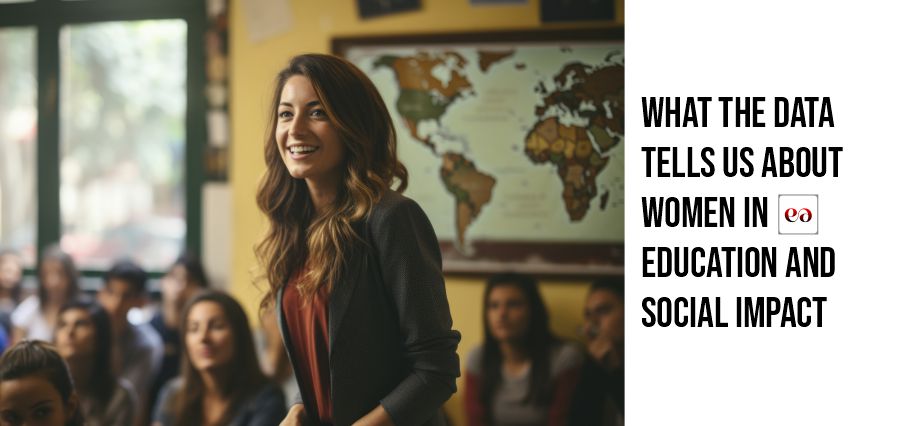
Education for girls and women has advanced significantly over the past decade. According to global data, since 2015 there are 50 million more girls enrolled worldwide. That rise covers primary, lower secondary and upper secondary levels. The net result draws attention: more girls sitting in classrooms, completing higher levels of education, learning skills that promise to reshape societies. While 122 million girls remain out of school globally, those gains already hint at the far-reaching influence of education on women and the societies they live in.
This blog explores what research and data reveal about the impact of educating women. It unpacks economic, health, social and generational effects. What emerges is not a narrow story about individuals, but a broad story about communities, nations, future generations.
Over the past two decades gender disparities in access to school have narrowed significantly at primary and secondary levels. Recent tracking shows almost equal rates of primary school enrollment for girls and boys globally. Secondary enrollment gap has also shrunk substantially. Higher education too records growth. In 2000 the global gross enrollment rate of women in tertiary education stood at 19%. By 2020 it grew to 43%. That doubling signals expanding opportunities.
Access to education remains uneven. Vast inequalities persist within and between countries, shaped by wealth, gender, caste or ethnicity, and geography. Data sources for over 160 countries highlight how intersecting conditions, poverty, location, social background, influence who gets to stay in school and who drops out. That context matters when evaluating progress.
Education lifts women into the workforce more easily. More education leads to better chances for stable work, higher income, and greater control over economic resources. In regions where female education improves, labour force participation rises. That shift benefits individuals and families immediately. Over time it contributes to national economic performance.
Studies have found that when more women complete secondary or tertiary education, national economies expand more rapidly. Women bring under-used potential into the workforce. Their engagement can reduce poverty, raise household incomes, and support sustainable economic growth.
The ripple effect extends beyond individual families. Educated women tend to invest more in their children’s schooling, health, and nutrition. Educated mothers often know more about health practices, immunization, nutrition, hygiene. That translates to better-educated next generation and stronger communities.
Quality education for women influences health in multiple ways. Women with schooling are more likely to make informed decisions about health care. Research shows that education among women links to better maternal health, lower infant and child mortality, reduced fertility rates, healthier practices for child-rearing. Education empowers women to understand nutrition, hygiene, disease prevention.
Education also supports mental and emotional well-being. In one study, higher education among women correlated with greater overall well-being, less psychological distress, increased positive affect and healthier behaviours such as exercise and social engagement. That effect emerges even when controlling for income levels.
In societies where women are educated, social norms begin to shift. Education challenges traditional gender roles and stereotypes. It creates opportunities for women to exercise choice, in marriage, career, family, and to be active participants in communities. Over time that helps reshape expectations and broadens what is possible for future generations.
Educating women changes societies through multiple channels. First, it supports gender equality. When girls and women access the same schooling as boys, it sends a message that opportunities should not depend on gender. That matters for fairness and human dignity.
Second, educated women often play larger roles in decision-making in households and communities. Their education strengthens confidence, critical thinking, and agency. Women who understand their rights and potential tend to claim more control over choices in family, work and social life. That fosters more balanced social dynamics.
Third, educating women affects the next generation. Women who have had good schooling often prioritise education for their children, invest in their well-being, and foster environments that value learning and growth. That creates a virtuous cycle: education for one generation raises prospects for the next.
Societies that invest in women’s education tend to see long-term social gains, reduced poverty, better health outcomes, more stable families, improved civic participation.
Progress in women’s education remains uneven. Millions of girls remain out of school. Inequalities based on poverty, location, caste or social background continue to restrict access. In some places structural barriers such as social norms, child-marriage, early motherhood, safety concerns, and lack of school infrastructure limit girls’ education.
Even where girls get into school, disparities endure in fields of study. Women remain under-represented in science, technology, engineering and mathematics (STEM) disciplines globally. That limits career opportunities in high-growth sectors and perpetuates gender imbalance in innovation and leadership roles.
At higher education and research levels, women remain under-represented. Although women now enroll in universities in greater numbers, only a minority enter or remain in research roles. That reduces the potential of women to contribute to knowledge creation, policy design, scientific discovery.
Societal norms and expectations pose another barrier. Gender biases and stereotypes persist. In many societies educating women remains undervalued. Educational progress for women still depends on proactive policies, community support, and efforts to dismantle systemic inequality.
When women gain education, societies gain more than individual achievement. The impact spreads, to families, communities, nations. Educated women contribute economically, socially, and culturally. They foster healthier families, support children’s learning, challenge limiting norms, and participate in civic life.
The ripple effect may take years to fully show but it begins early. A girl in school today might grow up to become a mother who ensures her children attend school. She might earn a decent living to support her family and community. She might participate in local governance or community efforts and advocate for education or health.
In places where women’s education improves across generations, societies often see meaningful transformation. Poverty declines. Literacy improves. Health outcomes become better. Social mobility increases. Economic growth strengthens. Opportunities widen for everyone.
Women’s education represents more than a moral or humanitarian ideal. It stands as perhaps the single most effective lever societies hold for social transformation. Where girls and women have access to quality education, positive change follows. Economic growth rises. Health improves. Social norms shift. Opportunities for future generations expand.
If societies commit to enabling every girl and woman to learn, they invest in a future that includes prosperity, equity and dignity for all. The data shows the path forward. Many obstacles exist. But the benefits far outweigh the challenges. For communities and nations that value progress, investing in women’s education remains one of the smartest, most far-reaching choices.


Welcome to the future of digital storytelling, where creativity meets innovation. We’re not just a magazine platform; we’re a team of passionate visionaries committed to transforming how stories are shared, celebrated, and experienced in the digital age. Join us as we inspire, inform, and redefine the world of digital magazines.
© Copyright 2025 | educationeureka | All Rights Reserved.