
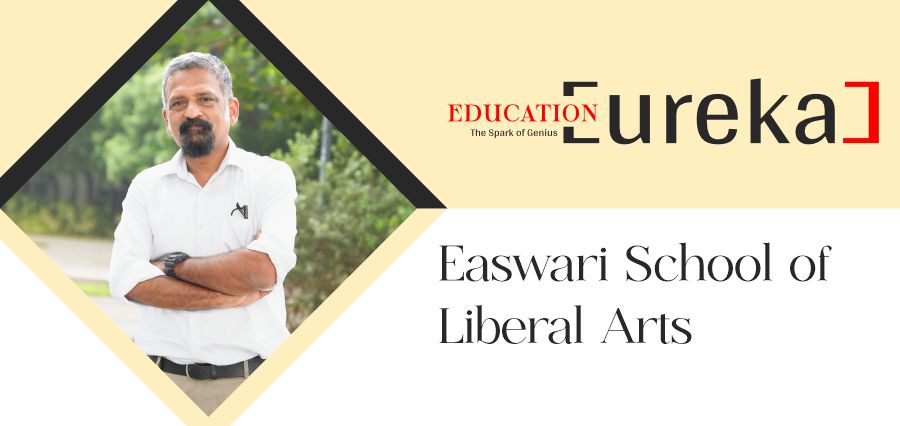
Creating a close community of learners who grow through open discussion, steady inquiry, and meaningful subjects!
Across Andhra Pradesh, families often build dreams around familiar fields. For many years, young people moved toward medicine. Later, a wave of Computer Science shaped choices across the state as the IT boom in India gathered force. This steady pull toward technical paths created a single pace for education. Liberal arts rarely entered everyday conversations, even as the world around students kept changing.
When SRM University AP prepared to grow its academic wings, Pro- Chancellor
Dr. P Sathyanarayanan imagined a place where three schools could rise with equal strength. One for liberal arts, one for engineering and sciences, and one for business and management. Each school would have its own space to think freely and carry its own character. This idea came to life even before Prof. Vishnupad arrived, yet it waited for someone who could shape it with steady purpose.
When Prof. Vishnupad joined as the first full-time Dean, he stepped into a landscape that needed care, courage, and belief in a wider form of learning. He understood the long history of selective academic demand in the state and saw why young people needed a place where different ideas, stories, and questions could grow. The push toward IT had created energy, yet it also left little room for subjects that explore society, culture, and thought.
The Easwari School of Liberal Arts grew from this shared vision. The aim was clear. Build a school that focuses on high-calibre students rather than large numbers. Create a home for liberal arts in a region where such choices rarely reached young minds. This school became a promise of wider learning, steady curiosity, and a fresh path for the next generation.
When people ask what draws someone into teaching, the story often starts long before the classroom. In Vishnupad’s case, the path was shaped by family expectations, academic shifts, and a deeper search for identity.
He chose to become a teacher and educator for several reasons. His father was a bureaucrat and wanted him to follow a similar path. He completed his bachelor’s and master’s in political science with an intention to pursue Civil services but then went to the US for his PhD in Anthropology. It was during his doctoral journey that he came to terms with himself. Coming to terms with oneself is precisely what liberal arts accomplish.
His shift to the US was extremely challenging. There is a way in which individuals constitute themselves when the other addresses them. When the gaze of the other falls on them, or when the other speaks to them, that is when they constitute themselves as human beings. When that does not happen, one begins to disappear. That was precisely his experience as a brown male in a small university town in northern part of New York state.
He spent a lot of time reading, reflecting, and meditating as part of his self-discovery process, progressively delving into the field of psychoanalysis. Entering the space of critical thinking and understanding the self, he decided to become an educator because he wanted to share his insights on how liberal arts aid in self-discovery with young people who might be open to the same journey.
Every school faces the task of shaping not only sharp thinkers but grounded human beings. Prof. Vishnupad approaches this balance by looking closely at what teenagers carry when they walk into a classroom.
He notes that the school’s philosophy recognises that when 16–18-year-olds join, they arrive from environments shaped by peer expectations, parental pressures, and the influence of social media. They often come in a heightened state of anxiety or frenzy, and the school believes they require a space to pause, breathe, and regain balance. This nurtures emotional growth, stability, and a coming to terms with oneself that the school consistently strives for.
He adds that engagement with thought, through prescribed texts across literature, social science, or any discipline, allows students to understand themselves fully. It echoes Gandhi’s concept of swaraj, the idea of self-mastery and governing one’s own mind and actions. Through thoughtful learning, he hopes students experience this journey toward inner autonomy.
Modern life rarely fits into neat disciplinary boxes. Vishnupad highlights how ESLA’s approach prepares students for this complexity. At Easwari School of Liberal Arts, the larger philosophy emphasises teaching students not only to build careers through rigorous engagement with their disciplines but to learn essential life skills. This approach sets their liberal arts programme apart from traditional social science programmes. Students in the first year undertake mandatory foundational courses, irrespective of their majors. It is only from the second year that they focus on chosen majors.
He points out that the curriculum offers expansiveness through electives and specialisations. A psychology major can take a minor in management. An economics major can pursue coding or computer science. This flexible framework with multiple pathways sets the school apart from traditional social science and humanities education. Through their philosophy, curriculum, and initiatives, they aim to support the intellectual, emotional, and ethical development of every student.
Any institution that values tradition must also evolve. Vishnupad describes how ESLA threads this needle. He stresses that the emphasis on foundational elements of each discipline remains central. Alongside that, the school focuses on interdisciplinarity, giving students a broader vision and understanding of their place in the world.
He points to the global shifts in political economy and technology over the last 10 to 15 years. Newer categories have emerged in every field. The goal is to train students to engage with these trends by developing capacious thinking and problem solving. The school ensures that students develop the ability to articulate and communicate their thoughts in changing times.
With a contemporary curriculum, they open students up to many possibilities. In media studies, new roles such as digital content creator, media analyst, or ethics consultant have emerged. In economics, behavioural economists, data scientists, crypto economists, and sustainable finance specialists are now recognised roles. The marketplace keeps evolving, and ESLA aims to prepare students to navigate these shifts. Much of this readiness is embedded in the curriculum across departments.
Technology often feels like an obstacle in today’s classrooms. Vishnupad views it as a tool that can be reoriented to support learning. He notes that technology is critical to classroom functioning. For English majors for instance, the advanced language laboratory is essential. The school offers world class, technology enabled spaces such as smart classrooms and active learning rooms.
He adds that teachers are now competing with screens for student attention. Since screens are part of daily life, the challenge is to mobilize them to draw students’ attention. In this way, technology becomes a tool that strengthens teaching and pedagogy.
Academic excellence is one thing. Real world thinking is another. Vishnupad points to how ESLA evaluates the latter. He describes how internships are built into the curriculum across the undergraduate years. Beyond classroom teaching, field experience is crucial.
During the first year, students from all disciplines complete a two-week summer immersion programme at top NGOs. They experience the ground realities of India and encounter issues related to livelihood, education, and equality. In the subsequent three years, the students undergo several internships during summer breaks and also during the semesters
Knowledge from books matters, but experience in the Indian context helps students develop critical thinking and problem solving in a more grounded way.
Starting a liberal arts school in India brings unique hurdles. Vishnupad lays out how ESLA has met them head on. He identifies one local and one global challenge. Andhra Pradesh has not traditionally embraced liberal arts education, making it tough to root such a programme. Globally, STEM fields have long dominated. Only recently has STEAM included the arts as essential.
In response, the school also communicates its broader philosophy that helps students cope with uncertainties and job market shifts. The curriculum is built on strong disciplinary foundations while emphasising interdisciplinarity and experiential learning.
He also points to the school’s strong faculty cohort. They have gathered young scholars from premier universities and top QS ranked institutes. Their team includes post docs from Harvard, University College London, and scholars from Columbia University, the University of New York, Rutgers, Columbia University and NYU. This collective expertise shapes the school’s orientation and identity.
A sense of belonging does not happen by accident. Vishnupad highlights how ESLA nurtures it. He notes that summer internships promote deep engagement with the community. Community service is built into the NEP aligned curriculum through a credit system that requires students to work with communities during the first two years. Subsequent internships consolidate this engagement with community development. This creates an ethical foundation around service that anchors the liberal arts curriculum.
Growth for a liberal arts institution involves both vision and discipline. Vishnupad outlines what he sees for ESLA’s future. The larger vision is to establish a distinctive liberal arts school in Andhra Pradesh. Alongside traditional disciplines, the school plans to launch new programmes in performance arts such as music, theater, and dance. This will position ESLA as a comprehensive liberal arts institution in the region.
They aim to stabilize their student body at about 150 students per year. Another priority is strengthening ESLA’s identity as a homegrown Andhra Pradesh brand with national reach. Currently, 20 percent of students come from outside the state. They aim to raise this to 30 to 35 percent to enrich the cultural and intellectual diversity of the student community.

Welcome to the future of digital storytelling, where creativity meets innovation. We’re not just a magazine platform; we’re a team of passionate visionaries committed to transforming how stories are shared, celebrated, and experienced in the digital age. Join us as we inspire, inform, and redefine the world of digital magazines.
© Copyright 2025 | educationeureka | All Rights Reserved.