
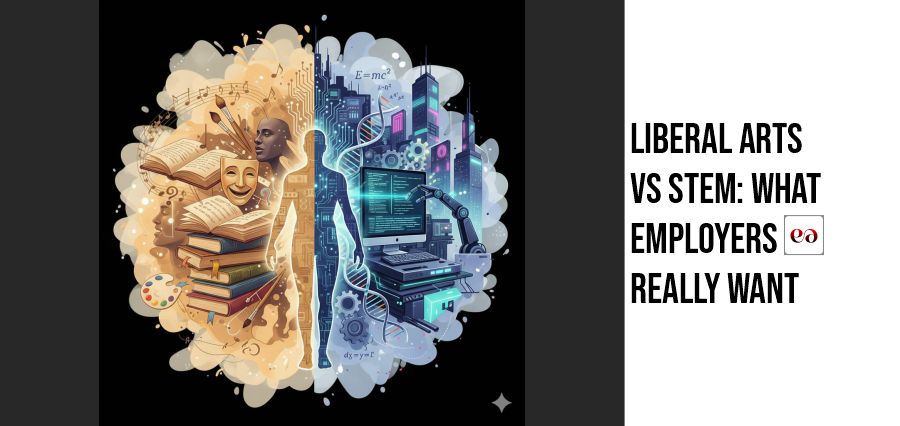
Parents, students, and educators continue to argue over the value of a liberal arts degree versus a STEM degree. The discussion gets emotional because people link education to financial security and dignity. Some insist that science, technology, engineering, and math degrees guarantee better careers. Others defend the liberal arts as the foundation of a thoughtful, adaptable workforce.
Employers sit at the center of this. They determine who gets hired and who moves ahead. When you listen carefully to hiring managers and industry surveys, a clearer picture emerges. The STEM advantage exists, but it is only part of the story.
Research from major hiring organizations reveals a pattern: companies look beyond technical competence. They express consistent demand for communication, collaboration, empathy, and analytical reasoning. These are core liberal arts competencies.
At the same time, employers need workers who understand digital systems, data, and technology. These are the core competencies of STEM programs.
The takeaway is not either-or. Employers want both dimensions in one employee, and they prefer when a candidate shows evidence of learning agility across fields.
When employers describe ideal employees, they repeatedly highlight skill sets that come from humanities and social sciences. Let us break them down in practical terms.
Liberal arts students write constantly. Clear written communication reduces errors, resolves conflicts, and improves persuasion. Companies value people who can synthesize complex information into digestible messages. Proposal writing, client communication, and internal reporting depend on this strength.
A history or philosophy major develops reasoning frameworks that help them evaluate evidence and ambiguity. Organizations face uncertainty and volatility, and leaders need staff who can analyze problems that do not have a formula.
Group discussions, presentations, and discourse-driven classes sharpen listening skills and awareness of different viewpoints. Leadership roles increasingly require empathy. Liberal arts training encourages this mindset.
Employers like workers who can generate original ideas, pivot when needed, and connect dots between unrelated concepts. Creativity drives innovation in every industry. Even engineering and finance firms recognize that the next breakthrough often begins as a creative insight.
STEM degrees prepare students for work that demands precision, quantification, and technical mastery. Employers actively recruit these skills.
STEM graduates are comfortable with databases, algorithms, spreadsheets, and digital models. Even nontechnical roles require interaction with software tools and data.
Engineers, coders, and scientists receive systematic training in breaking a challenge into steps. That mindset improves efficiency and reliability across departments from operations to supply chain.
Companies rely on employees who understand metrics and statistical patterns. Financial modeling, forecasting, and optimization work require these abilities.
STEM coursework trains students to test hypotheses, collect evidence, and revise conclusions. That capacity supports innovation and process improvement.
Recruiters describe a gap between what students study and what companies need. They often report frustration not with technical deficits, but with missing interpersonal skills. Many HR executives repeat that technical abilities are teachable, while communication, initiative, and leadership are harder to train.
At the same time, some employers struggle to find graduates proficient in coding, advanced statistics, cybersecurity, machine learning, and automation tools. The pipeline for technical talent remains stretched, especially in sectors undergoing digital transformation.
The result is a labor market hungry for hybrids: candidates who can write and code, speak persuasively and analyze data, understand people and systems. Degrees alone rarely signal that combination.
Companies move fast. Roles evolve constantly. Software tools become obsolete. Graduates who rely on memorized skills risk falling behind. That is why employers highlight adaptability and continuous learning.
Hybrid employees help teams bridge internal silos between strategy and implementation. They can interpret insights from data scientists for executives. They can translate customer needs into product specifications. They can debug a process and also facilitate a constructive meeting.
Tech firms sometimes hire liberal arts majors for product or UX roles because they can empathize with users. Consulting firms sometimes hire STEM graduates for analytic tasks but promote those who learn to communicate. The workforce rewards cross-functional fluency.
Some liberal arts graduates struggle when confronting software systems, spreadsheet modeling, or quantitative reporting. Managers expect employees to be self-sufficient with tools like SQL, Python, or even advanced Excel.
Students who avoid math or tech courses sometimes miss opportunities that demand digital fluency. Hiring managers interpret this as reluctance to learn, rather than lack of exposure.
In competitive markets, a liberal arts degree without demonstrable technical skills can make interviews harder.
Employers often promote people who influence teams and navigate office politics gracefully. STEM students who focus solely on technical mastery risk being perceived as rigid or isolated.
Weak writing or presentation skills can stall career growth. Engineers must persuade investors and stakeholders. Data analysts must communicate insights to leaders without technical backgrounds. Scientists must advocate for research budgets.
Without those communication skills, their technical ability may go unnoticed.
Students control more than they realize. A degree signals training, but employers care about demonstrated skills. Candidates improve their value when they intentionally combine fields.
Here are strategies that strengthen employability for any major:
• Liberal arts students can learn basic programming, statistics, or data visualization tools.
• STEM students can take writing, ethics, or public speaking classes.
• Internships help candidates show real-world experience.
• Capstone projects and portfolios prove ability to apply skills.
• Multidisciplinary clubs develop leadership and communication.
• Certifications provide recognizable validation of technical competence.
• Networking and informational interviews offer insight into employer expectations.
Automation and AI reshape tasks. Routine work will decline. Skills involving interpretation, creativity, analysis, empathy, and ethical reasoning will become more important. Liberal arts programs emphasize these competencies.
At the same time, organizations will integrate advanced analytics and digital platforms into daily work. Employees without technical literacy will struggle. STEM programs prepare students for that environment.
The workers who thrive will combine competencies from both sides. Degrees that isolate students inside one silo will feel outdated. Programs that blend humanities and technology will rise.
The perception that one degree guarantees security is misleading. Markets shift. Industries collapse. New industries emerge. Universities should prepare students for lifelong learning, not a single job title.
Employers want employees who think critically, write clearly, analyze data, work in teams, and adapt to change. Liberal arts degrees and STEM degrees each provide part of that package. Graduates who supplement weaknesses and showcase hybrid strengths will stand out.
For a student choosing a major, the smartest move is to build a toolkit that spans communication, technology, empathy, and quantitative reasoning. Land a degree, but more importantly, assemble a skill portfolio employers recognize.

Welcome to the future of digital storytelling, where creativity meets innovation. We’re not just a magazine platform; we’re a team of passionate visionaries committed to transforming how stories are shared, celebrated, and experienced in the digital age. Join us as we inspire, inform, and redefine the world of digital magazines.
© Copyright 2025 | educationeureka | All Rights Reserved.