
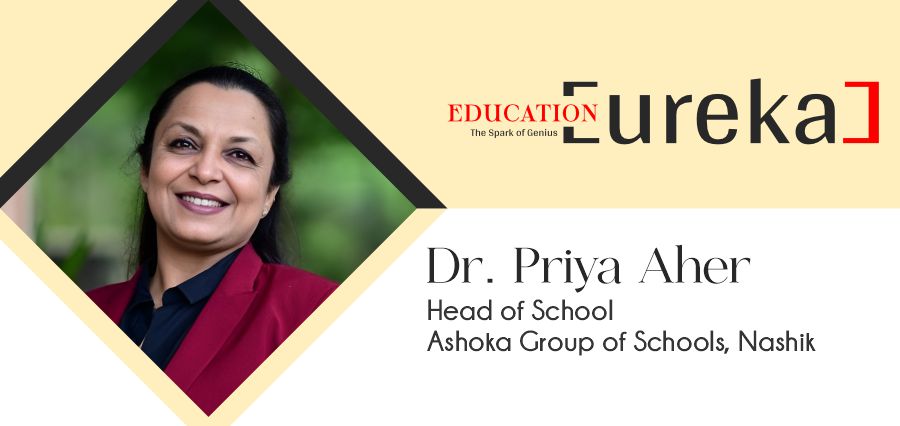
Encouraging a future where education becomes a force for nation-building and a space where dreams find direction and identities take shape!
A single spark of curiosity in a child can shift an entire path. Many caregivers remember the moment a young learner asks a question that expands the room. It might be a simple wonder, yet it holds the promise of a new world. This spark cultivated the life of Dr. Priya Aher and became the anchor of her work.
Growing up, she noticed how some children thrived when they felt heard. A word from a teacher could bring courage, while a space could build confidence. This early observation grew into a lifelong purpose. She chose medicine to understand the human body, psychology to understand the human mind, and education to guide young dreams. Each step added a layer to her vision.
Priya believes that every learner holds a voice waiting for direction. She often says, “I have learned that the mind thrives on knowledge, the heart thrives on belonging, and the spirit thrives on purpose. Our schools must nurture all three.” This idea guided her leadership at Ashoka Group of Schools.
Today, as a Head of School, she aims to build classrooms that breathe life into these three pillars so that children rise with confidence and curiosity. She sees the future as a place that calls for courageous thinkers, inventive minds, and compassionate leaders. Her work focuses on shaping such young citizens. Under her guidance, classrooms turn into spaces where ideas are encouraged, questions are welcomed, and creativity has room to stretch. Educators feel renewed purpose, and students feel safe to explore.
Her vision is simple in words and powerful in action. She dreams of schools where learning feels like a privilege. A space where pressure fades, and students walk toward meaning. A place where marks matter less than growth, and curiosity holds real value.
Priya notices how a child’s eyes shine when understanding arrives. That moment assures her that the future is already turning brighter. Through her work, she carries the belief that education can build a stronger nation, one mindful learner at a time.
Let us learn more about her journey:
The journey into any field begins with a conviction. In Priya’s case, that conviction grew from the worlds of medicine and psychology and eventually pulled her toward education. The transition made sense to her because it aligned with everything she believed about human potential.
Her professional journey has been formed by a deep belief that education is where transformation truly begins. While her background in medicine taught her how to care for human life, and psychology helped her decode human emotions and behaviour, it was education that allowed her to influence human potential at its earliest and most powerful stage.
She stepped into education because she wanted to create more than academically strong students. She wanted to help build resilient, empathetic, and future-ready individuals. As a psychologist and career counsellor, she often witnessed how the right guidance at the right time can completely change a child’s trajectory. That realization became her strongest motivation.
Education today demands innovation, inclusion, and a personalised approach. She is passionate about nurturing environments where learning becomes joyful, where every learner feels seen and valued, and where their unique talents are celebrated. She firmly believes that when a child’s emotional and cognitive growth come together, the foundation for a stronger society is built.
What drives her every single day is the opportunity to be a catalyst, whether it is by empowering educators, designing student-centric learning spaces, or guiding young minds to discover their purpose. Her work blends the scientific insight of a medico, the empathetic lens of a psychologist, and the visionary spirit of an educationist.
Leadership grows from a shift in perspective. For Priya, that shift was the understanding that leading in education means shaping ecosystems that influence lives far beyond the classroom. This realisation became a turning point in how she leads today.
The defining moment in her journey was the realization that leadership in education is ultimately an act of responsibility towards learners, towards society, and towards the future. Over the years, one belief has guided every step she takes. Education must be rooted in integrity, empathy, and purpose. When these values lead, excellence naturally follows.
Coming from a medical and psychological background, she has always viewed each child as a whole individual with unique emotions, talents, and dreams. This perspective changed the way she leads. Instead of focusing only on systems and outcomes, she began prioritizing human connections, ethical decision making, and a culture where trust and transparency thrive.
At Ashoka Group of Schools, she strives to nurture a leadership ecosystem where values are not taught merely through lessons but lived through actions. Whether it is ensuring fairness in opportunities, encouraging honest dialogue, or empowering teachers to innovate fearlessly, every decision is anchored in strong moral principles. She believes that when students witness integrity in action, they learn to practice it for life.
Her leadership today is formed by a commitment to build environments where every learner feels respected, every teacher feels valued, and every challenge becomes an opportunity to grow. She sees herself not as someone who stands above others, but as someone who stands with them, guiding, listening, and inspiring.
If there is one turning point she carries with her, it is this. True leadership is measured not by how many people follow you, but by how many people rise because of you. And that is the impact she aspires to create every single day.
Students often learn best when they uncover understanding on their own. That is the idea this reflection speaks to, and Priya’s perspective fits right into that space where curiosity turns into clarity.
Priya describes a unique and indescribable joy in watching a student make a discovery on their own. The moment their eyes light up, when curiosity turns into clarity, becomes the space where true learning blooms for her. She draws from cognitive science, noting that understanding that is self constructed is retained longer, applied better, and fuels deeper motivation. That moment reminds her of why she chose education as her purpose.
At Ashoka Group of Schools, she and her team intentionally create environments where students learn through experience rather than passive instruction. Whether through inquiry based projects, role play, real world simulations, experiments, or collaborative problem solving, learning becomes something children do, not just something they hear. When students connect concepts to their lives, the learning becomes embedded in their thinking, not just in their notebooks.
She and her colleagues actively integrate strategies grounded in educational research:
For teachers, she cultivates professional spaces that encourage creativity and innovation. When educators feel equipped and inspired to design such experiences, the classroom shifts from a place of instruction into a hub of discovery.
For Priya, seeing a student figure it out is witnessing confidence being born, confidence that will guide them far beyond school walls. That is why she chooses to lead with discovery every single day. When children learn how to learn, they can navigate any future with purpose, curiosity, and courage.
Parents and educators often wonder how to hold academic growth and emotional development at the same time. Priya’s view treats them as inseparable, and her approach brings the two into daily practice.
Priya believes that academic excellence and emotional intelligence are not two parallel goals. They are deeply interconnected. A child who feels valued, confident, and emotionally secure naturally performs better academically, and that understanding shapes the core of her approach at Ashoka Group of Schools.
She holds the conviction that schools must first be a happy place where students wake up excited to learn, grow, and belong. To support this, the school has built their own Happiness Curriculum that blends gratitude, respect, compassion, mindfulness, and joy into everyday learning. It ensures that every child discovers not only what they can achieve, but who they can become.
She nurtures emotional intelligence with purposeful structures:
For Priya, gratitude and respect are not lessons from a textbook. They are values lived daily through interactions, student leadership roles, and a culture of kindness. Teachers engage in reflective circles and well being activities as well, because their emotional health directly affects classroom energy. A joyful teacher ignites joyful learning.
When emotional intelligence and academics move hand in hand, she believes schools go beyond preparing children for examinations. They prepare them for life. In her view, this balance of mind and heart defines true education and forms the legacy she works toward every single day.
Real learning often hides in the small details that many overlook. Priya pays attention to these subtle signs because they reveal whether thought, curiosity, and emotional safety are truly present.
Priya holds that true learning is rarely loud, but it is always alive. When she walks into a classroom, she looks for the subtle yet powerful indicators that students are not just hearing but thinking and feeling their learning.
She notices it in curious eyes that follow ideas with fascination. She notices it in whispers of collaboration, where students learn from each other, not only from the teacher. She notices it in the comfort of mistakes, where children are unafraid to try, fail, and try again.
There are many invisible signs she watches for:
Sometimes the room may even appear slightly chaotic, yet it is the chaos of creativity and discovery.
For Priya, the most telling sign is simple. Students are smiling while learning. There is joy, pride, and a sparkle of accomplishment. These moments show that education is touching both the mind and the heart. She believes that true learning lives in the energy of the room. When students feel safe to explore, are encouraged to question, and are excited to grow, she knows real learning is taking place.
Large institutions often struggle to hold on to closeness as they grow. Priya believes scale should never dilute soul, so she grounds her approach in purpose before anything else.
She shares that growth is meaningful only when the core values remain intact. At Ashoka Group of Schools, even as the community expands, her purpose stays deeply personal. Every student must feel seen, every teacher must feel valued, and every parent must feel connected. That sense of intimacy comes from a culture where relationships matter as much as results.
She highlights that every branch, classroom, and learning space must reflect the same ethos of respect, empathy, and a child-first mindset. Open communication, accessible leadership, and active listening remain foundational in the system. She nurtures collaboration instead of competition among branches so the identity of Team Ashoka stays strong.
Her reminder is simple. Structures may be large, but the approach stays human.
Most importantly, she holds on to the belief that every individual deserves a place where they belong. Growth has only given the team more hearts to nurture and a greater responsibility to stay grounded. Scaling up has strengthened her mission. She aims to build not a chain of schools but a connected community of compassionate learners and leaders. When purpose drives expansion, intimacy does not disappear. It becomes the reason behind success.
Decision-making in education carries weight because every choice shapes classrooms, teachers, and families. Priya does not make decisions on autopilot. She pauses and checks her inner compass before moving forward.
She reflects on a few key questions each time.
As both a psychologist and an educationist, she balances logic with empathy. Research directs the team toward what works academically, while compassion keeps attention on the hearts being shaped. She often reminds herself that behind every statistic is a child with dreams, a teacher with passion, and a family placing trust in the institution.
She also pauses on one grounding thought. What would I decide if the child sitting in that classroom were my own?. That question anchors her every time.
For Priya, leadership is not about choosing what is easiest. It is about choosing what is right, even when it takes longer, costs more, or demands courage. When decisions centre on students and uplift educators, the outcome supports growth and happiness.
At the end of her internal process, she always returns to one direction. Do what helps children thrive emotionally, intellectually, and morally. If the answer aligns with that purpose, she knows she is on the right path.
Education never stands still. New ideas, new challenges, and new needs appear constantly. Priya treats that reality as fuel rather than pressure. She stays inspired by being a learner first. She keeps reading, connects with educators across the world, attends conferences, and stays updated with research so she can reimagine what is possible. Her published state and national level research papers, along with her PhD work on Home and School Influence on Academic Achievements of Students, strengthen that mindset and offer parents and educators practical insight into how children learn.
But students remain her sharpest source of insight. Their curiosity, fearless questions, and evolving worldviews remind her that leadership must stay adaptive, grounded, and ready for what comes next. She evolves by listening to the people closest to the work. When teachers share challenges, when parents voice aspirations, and when children dream out loud, she finds direction. Inspiration, to her, comes from being deeply rooted in purpose while courageously embracing new ideas.
Learning works best when it feels like an ongoing exchange of ideas, not a checklist. With that in mind, Priya offers her perspective on what schools can bring to this lifelong dialogue.
She believes that if education is a lifelong conversation, then schools must contribute the voice of curiosity, courage, and character. She shares that they are the first space where children learn how to ask bold questions, how to collaborate with others, and how to understand themselves. Her view stays centred on one idea. Their voice must remind every learner that knowledge is not a destination. It is a journey of discovery.
She adds that schools must help children build the language of empathy, the lens of global citizenship, and the confidence to learn, unlearn, and relearn throughout life. In that grand dialogue of growth, she holds that the role of schools is to instill the joy of inquiry and the conviction that each individual’s voice deserves to be heard.
Teaching often slips into routine, so the challenge is helping educators feel inspired again. Here is how Priya approaches it. She observes that teachers are the heartbeat of a school, and when their enthusiasm shines, classrooms come alive. To keep that sense of wonder intact, she and her team prioritize teacher growth and emotional well-being. Through collaborative planning, reflective circles, professional development programs, and teacher-led innovation initiatives, educators receive space to explore new ideas and rekindle creativity.
She notes how they are encouraged to experiment fearlessly, share success stories, celebrate small breakthroughs, and step into the shoes of a learner again. Many activities they design engage all senses, allowing them to feel the same joy that children feel.
Priya holds that when teachers feel trusted, appreciated, and intellectually stimulated, teaching stops being routine. It becomes a continuous adventure.
Every leader eventually faces a moment that shifts their worldview. Priya reflects on the one that transformed her understanding of education.
She describes the biggest challenge as the moment when education had to move from familiar structures to dynamic, unpredictable modes. Learning had to transcend walls, routines, and certainty. Guiding teams and students through fear, disruption, and change demanded resilience, empathy, and innovation at a level she had never seen before.
This experience reformed her leadership by proving that education cannot rely solely on fixed systems. It must remain adaptable, inclusive, and deeply humane. She realized that connection is as essential as content. The goal is not only to keep learning going, but to keep hope alive in every child.
That turning point changed her definition of education. To her, it is not preparation for life. It is life itself. Children need preparation not only for exams, but for uncertainty, collaboration, and courage. She trusts that this realization will continue to guide every decision she makes.
“Research gives us direction; empathy gives us purpose — education needs both.”
“A safe classroom is where mistakes are not feared, but celebrated as thinking in action.”
“Well-being is not an addition to learning; it is the foundation that learning stands on.”
“Schools should not produce followers of success; they should cultivate creators of change.”
Read Also – Why the World’s Greatest Teachers Are Often Women in Education

Welcome to the future of digital storytelling, where creativity meets innovation. We’re not just a magazine platform; we’re a team of passionate visionaries committed to transforming how stories are shared, celebrated, and experienced in the digital age. Join us as we inspire, inform, and redefine the world of digital magazines.
© Copyright 2025 | educationeureka | All Rights Reserved.