
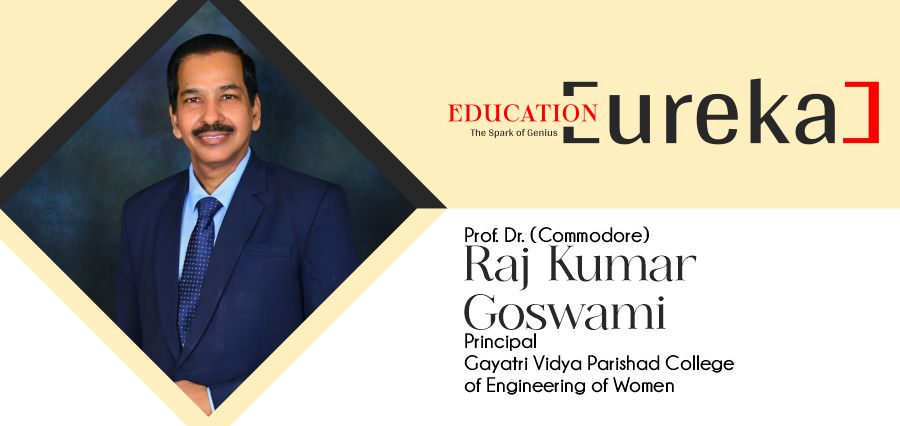
On a mission to raise academic standards, research culture, and professional confidence!
Some people walk into a room, and you sense calm before they speak. That steadiness sits at the heart of Prof. Dr. (Commodore) Raj Kumar Goswami. It comes from years of duty, reflection, and a lifelong belief that knowledge should serve people first.
As a young learner, systems and machines thrilled him. Solving problems under pressure felt natural. The Indian Navy gave that curiosity a home where engineering and national readiness work together. His Electrical Engineering training at INS Shivaji brought discipline, precision, and accountability into daily practice, values that became part of his identity.
Years at sea brought constant engagement with power systems, radar, sonar, electronic warfare, and communication on frontline warships. Naval work demands quick, reliable solutions with real consequences, and this experience influenced his approach to technology and leadership.
He pursued an M.Tech in Radar and Communication from IIT Delhi, specialising in underwater communication systems. Working with algorithms, signal processing, and real-time SHARC processors moved him firmly toward research. A Ph.D. from Andhra University strengthened this direction, linking theory with application across defence communication, signal processing, navigation, and underwater acoustics. Alongside, an MMS and advanced management courses helped him align people, processes, and systems for long-term excellence.
From Deputy Electrical Officer to Director of the Modernisation Monitoring Team and Additional Command Electrical Officer, he guided weapon systems, IT networks, radar and sonar platforms, and major projects. A landmark responsibility involved a Data Link communication system for warships with IIT Delhi, a time-bound national mission that earned high commendation. Mentoring crews, upgrading processes, and driving automation became central to his purpose.
After superannuation in 2020, he chose academia with deep commitment to teaching and mentoring. As a Principal of Gayatri Vidya Parishad College of Engineering for Women, he drove accreditation, autonomy, research culture, and higher intake. The college earned NBA reaccreditation, NAAC A grade, UGC autonomous status, and permanent affiliation.
His research journey spans more than 90 papers, 15 books, patents, and studies in AI, underwater communication, deep learning, image processing, and 5G. At the heart stands service with purpose, guiding future engineers with courage and care.
Let us learn more about his journey:
Raj Kumar’s transition from the Navy into academia did not feel like a departure. It felt like a continuation. He carried discipline, service, accountability, excellence, and people-centric leadership into classrooms and campuses and began interpreting them through education, research, and institution building. After three decades of commissioned service, culminating as Commodore, he had lived in environments where decisions carried immediate consequences. As he approached superannuation, he kept asking himself how experience and ethos might still serve the nation.
He concluded something important. Defence safeguards the present. Education shapes the future. That realization widened his purpose.
In academia, discipline needs cultivation instead of command. As Principal of Gayatri Vidya Parishad College of Engineering for Women, he introduced punctuality, process adherence, documentation, review mechanisms, and outcome-based planning as tools for excellence rather than enforcement. Slowly, predictability created trust.
He guided milestones such as NBA reaccreditation, NAAC A grade, permanent affiliation, AICTE intake enhancement, and autonomous status as part of a long-range roadmap, not as isolated achievements. His long-held belief remained intact: systems do not win wars. People do. Mentoring women engineers gave his role social meaning, anchoring education as service.
Authority shifted into shared accountability. Transparent academic audits and review systems built institutional ownership. Research moved from classified missions to open collaboration.
He also recognized academia’s emotional landscape: aspiration, anxiety, creativity, and failure coexist. Literature and poetry reminded him that leadership needs empathy alongside structure.
In reflection, he does not see two separate lives. He sees an expanded leadership identity. The Navy gave structure. Academia added depth. Command matured into mentorship. Operational missions turned into an educational vision. Today, he believes that building institutions and shaping minds stands as essential to national strength as guarding borders. For him, leadership in education is a continued form of service grounded in ethics, critical thinking, and contribution.
Raj Kumar’s philosophy as Principal rests on leadership instincts forged at sea. The Navy taught him early that rank carries responsibility more than privilege. Every decision has consequences. In academia, this translates into stewardship of systems, people, compliance, and mission.
He believes mission clarity prevents drift. Ambiguity weakens institutions in the way it once threatened operations. He insists alignment must be visible and shared. Discipline, to him, is not rigidity. It becomes resilience. Structured calendars, transparent evaluation, documentation, and audit readiness create fairness instead of fear.
He centers people. Trained, motivated teams determine outcomes. Students are future professionals. Faculty are intellectual partners. He models credibility by continuing research and scholarship, proving that leadership and learning cannot separate.
Decision-making remains timely and grounded. He avoids indecision. Ethics remain non-negotiable. Admissions, governance, examinations, and appointments must hold up to scrutiny. Integrity serves as institutional currency.
Continuous learning still defines relevance. Just as defence demanded technological readiness, academia requires engagement with AI, data science, communication systems, and management thought.
He also prizes institutional continuity. Leaders leave. Systems should not collapse. His goal has been sustainable processes rather than personal legacy.
In his view, the uniform changed, but the mission never did. The principles remain constant: clarity of purpose, integrity of action, respect for people, accountability, and excellence.
Raj Kumar did not follow a single linear academic path. Engineering formed his intellectual discipline, teaching him to deconstruct complexity and respect evidence. In classrooms, he encourages conceptual clarity, not memorization. In leadership, he sees colleges as interconnected systems requiring alignment.
Management education reshaped how he translated ideas into execution. It revealed resource limits, motivation, change management, and stakeholder complexity. Institutional reform, he learned, is not technical alone. It is human. Leadership becomes an enabling structure so others succeed.
Psychology expanded perspective. Underperformance often reflects fear, doubt, or exclusion rather than intelligence. Faculty respond to respect more than directives. Mentoring, conflict resolution, and performance conversations became more effective when guided by psychological insight. It also deepened his self-awareness.
Yogic education added balance. It emphasized inner discipline and regulation, reminding him that leadership must remain centered during pressure.
Together, these fields shaped a holistic philosophy. Engineering offers structure. Management provides direction. Psychology brings empathy. Yogic education sustains balance.
In practice, this integration shows up as:
Leading an engineering institution for women reinforced the need for this wholeness. Students require knowledge, confidence, resilience, and ethical grounding at once.
He now believes education must function as a whole-person enterprise. Integration over specialization. Wisdom over information. Purpose over position.
The conviction that education is a social responsibility crystallized for Raj Kumar when he took charge at GVP College of Engineering for Women. Young women arrived with aspirations and limited financial safety nets. The college often determined independence.
During a high-stakes accreditation phase, delays threatened intake, employability, and credibility. Some advised minimal effort and postponement. He rejected the suggestion. He asked himself a simple question: If these were my own children studying here, what standard of education would I accept? The answer was unequivocal that nothing less than excellence with integrity.
Instead of opting for incremental or cosmetic measures, he made the decision to pursue comprehensive, system, level reforms, even though it demanded intense effort, cultural change, and short term discomfort. This included the following:
He understood accreditation outcomes carried human meaning. NAAC ratings influenced family trust. NBA recognition shaped placement. Autonomous status enabled curriculum relevance.
He drew upon defence principles: the weakest link determines institutional readiness. So he built durable systems. He balanced compassion with rigor, believing lowered standards ultimately betray students.
He remembers validation: a student regaining confidence, a faculty member rediscovering academic enthusiasm, parents expressing relief. Education became ethical leadership depending on conviction, not convenience.
Raj Kumar changed how accreditation was perceived. He repeated a simple truth:
“Accreditation is not about impressing assessors; it is about assuring our students and society that we deliver quality education.”
He moved the institution from checklist thinking to long-term quality. Instead of preparing for cycles, he built systems that naturally met standards.
He redistributed responsibility. Committees gained real ownership. Departments interpreted the NBA and NAAC criteria contextually. The faculty showcased their work with pride.
He emphasized outcomes and data. Course Outcomes, Program Outcomes, and Program Educational Objectives were aligned. Continuous improvement became normal rather than reactive. Data evolved into insight.
He invested in capacity building through:
He balanced discipline with empathy. Workloads were acknowledged. Communication stayed open, two-way, and transparent.
He standardized procedures and strengthened internal quality systems to ensure continuity beyond individuals.
Throughout, he kept focus on students. Accreditation meant credible degrees, employability, and confidence. He remained personally involved, signalling seriousness.
The result included NBA reaccreditation and NAAC A grade, but more importantly, the emergence of a culture of continuous improvement. Accreditation became a habit of quality, not an event.
Raj Kumar’s resilience was tested by change resistance, regulatory complexity, external disruptions, and emotional strain. Introducing Outcome-Based Education and governance reforms created understandable discomfort. He relied on dialogue, clarity, and consistency rather than force.
Navigating AICTE, UGC, NAAC, and NBA frameworks required ethical resolve. Quick fixes tempted institutions. He chose deeper reforms despite pressure.
Pandemic disruption, digital learning transitions, and career uncertainty required steady communication. He emphasized clarity amidst uncertainty, without exaggerating certainty.
He confronted emotionally charged issues: grievances, conflicts, underperformance, and anxiety. Psychology training helped him regulate reactions and respond with empathy without surrendering fairness.
Long accreditation phases risked burnout. He paced initiatives, recognized effort, and practiced internal balance through yogic discipline.
Running a women’s engineering college demanded constant calibration. Maintain rigor. Expand support. Trust slow progress.
Transitioning from Navy command to academic persuasion required unlearning. Authority worked differently. He adapted.
He leaned on five anchors:
To him, resilience means absorbing change while protecting ethics and purpose.
Empowering women in STEM became central to Raj Kumar’s leadership. Students initially arrived with hesitation, shaped by conditioning despite capability. He built mentoring structures, leadership opportunities, and research exposure. Confidence slowly replaced doubt.
He watched students shift from passive learning to active ownership. They spoke up, questioned, led technical clubs, managed events, mentored juniors, and represented the institution. Leadership became initiative, not authority.
Ambitions expanded. Instead of “safe roles,” students began discussing research, entrepreneurship, higher education, and global opportunities.
Faculty transformation paralleled student journeys. Women faculty gradually stepped forward into leadership, guided accreditation efforts, published research, supervised projects, chaired committees, and shaped governance.
Research orientation grew. Initial hesitation turned into academic output. Faculty who once doubted themselves now authored papers and guided innovation. He saw myths dismantled. Women handled complex technical and leadership roles with resilience, analytical depth, and creativity.
Psychological empowerment mattered as much as achievement. Students learned to voice dissent respectfully, set boundaries, and trust their abilities. Institutional culture evolved. Collaboration replaced silence. Aspiration replaced limitation. Empowerment became identity.
Moments that reaffirm his mission include:
For him, empowerment is cultivated intentionally. It requires opportunity, trust, patience, and belief, and the ripple effect extends across generations.
Continuous learning is a responsibility in Raj Kumar’s mind. In the Navy, stagnation risked mission failure. Each new role required fresh knowledge. Curiosity became a habit.
Complexity pushed him across disciplines. Engineering revealed systems. Management illuminated organizations. Psychology explains human behavior. Yogic education taught inner regulation. Curiosity humbled him and prevented complacency.
Learning renews leadership. Research, teaching, and mentoring revive purpose. Reflection after failure teaches more than success. He reframes learning for students as empowerment instead of a transaction. Knowledge widens agency. He normalizes questioning. Curiosity becomes engagement.
For faculty, he defines learning as professional vitality. He models scholarship himself to signal authenticity.
He builds enabling systems:
He understands that expectations without capability cause frustration. Mentoring and training accompany ambition.
Gradually, curiosity becomes culture. Students explore independently. Faculty initiate collaborations. Teams suggest improvements proactively. Ultimately, he considers learning ethical. Society entrusts educators with futures. Remaining learners honor that trust.
Raj Kumar sees Indian institutions like GVPCEW offering qualities often underestimated globally. Students develop resilience working under constraints with high expectations, a realistic preparation for professional environments.
Indian engineering emphasizes fundamentals. Strong mathematics and core reasoning help graduates adapt across technologies.
He believes Indian education complements global systems by adding resilience, depth, values, and social purpose.
Raj Kumar believes education must cultivate competence and character together. At GVPCEW, academic excellence includes conceptual clarity, application, curiosity, and responsible use of technology. Emotional well-being becomes part of excellence.
He prioritizes psychological safety. Mistakes become learning steps. Respect remains non-negotiable. Transparent evaluation reduces anxiety. Mentorship anchors the institution. Students must feel seen beyond marks. Guidance extends into confidence, family expectations, and purpose.
He integrates emotional intelligence intentionally. Students:
Stress is addressed through reflection and balance rooted in yogic discipline.
Confidence grows through entrusted responsibility. Students coordinate projects, events, and innovation activities. Faculty development reinforces communication awareness, sensitivity, and mentoring ability. Leadership models composure and fairness.
He measures success through quiet indicators:
Balance is ongoing. Standards stay high while support remains humane.
When Raj Kumar reflects, the milestone defining his legacy is not a rank or medal. It is his decision to carry naval ethos into academia and build an institution capable of empowering generations.
His Navy years included mission-critical work, including contributions to indigenous defence technology such as the Data Link communication project with IIT Delhi. Yet those milestones felt bound by tenure.
The turning point arrived when he chose academia with intention. As Principal at GVPCEW, he guided institutional transformation:
These strengthened credibility and opportunity for women engineers.
Leading a women’s institution gave meaning. He watched hesitant students evolve into professionals and leaders. Naval discipline translated into academic systems. Command shifted to mentorship. Mission readiness became educational preparedness.
Legacy, to him, means the institution thrives without him. Systems endure. Culture stays ethical. Confidence persists. Service continues beyond the individual.
He believes service does not end when the uniform comes off. It changes form.
Raj Kumar offers principles shaped across service and scholarship. Education is a calling. True fulfillment lies in seeing others grow. Character must outweigh credentials. Integrity, humility, fairness, and consistency sustain leadership.
Learning must never stop. Curiosity prevents irrelevance. Discipline needs compassion. “Discipline builds systems. Compassion builds people.”
Lead through example. Authority may command, but example earns trust.
Leadership should remove obstacles, not control outcomes. It should build systems that allow others to succeed:
Invest in people. Institutions thrive on human development.
Embrace change thoughtfully. Develop emotional intelligence consciously. Measure impact over years, not moments. Remember, permanence belongs to institutions, not leaders. Build continuity. Keep your ego quiet. Return to purpose whenever fatigue surfaces.
He leaves them with one message: lead with integrity, learn with humility, serve with compassion, and remember the human lives behind every system. That is the work that endures.
His leadership blends service, method, and empathy. With each milestone, Prof. Dr. Raj Kumar persists to guide people and institutions toward disciplined growth, grounded in experience and an enduring quest for excellence.

Welcome to the future of digital storytelling, where creativity meets innovation. We’re not just a magazine platform; we’re a team of passionate visionaries committed to transforming how stories are shared, celebrated, and experienced in the digital age. Join us as we inspire, inform, and redefine the world of digital magazines.
© Copyright 2025 | educationeureka | All Rights Reserved.